Counting ACC sessions without a spreadsheet
Why the count drifts, where the errors come from, and what to do about the allocation that quietly expired in May.

Every solo practice I have looked at counts funded sessions the same way: a spreadsheet, one row per client, a number that gets decremented on a Friday afternoon when there is time. It works, right up until the week it does not.
The count drifts for three reasons, and none of them are carelessness.
The three places the count goes wrong
Cancellations that were already counted. You booked six, delivered four, and one of the remaining two was cancelled by the client the night before. Whether that comes off the allocation depends on the funder, and whether you remembered to go back and change the row.
Sessions delivered outside the allocation. A client on an ACC allocation asks for an extra session that the approval does not cover. You deliver it, because clinically that is the right call, and the spreadsheet quietly records it against the funded block anyway.
End dates nobody is watching. Allocations expire. A client goes on hold in March, comes back in June, and the approval ran out in May. The sessions you deliver in July are unfunded and you find out at invoicing.
The pattern underneath all three
The spreadsheet is a second record of something the calendar already knows. Every time the two disagree, the spreadsheet is the one that is wrong, because it is the one being updated by hand.
Count from the sessions, not alongside them
The fix is not a better spreadsheet. It is deleting the spreadsheet and letting the count fall out of the work you already record.
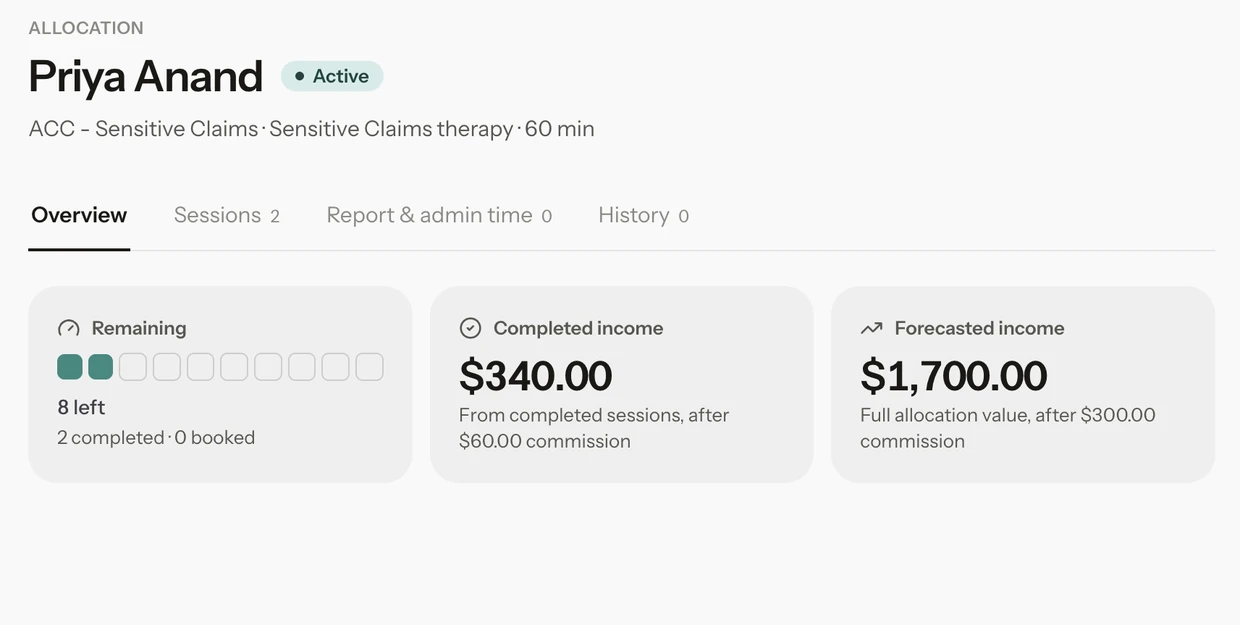
If a session carries its allocation, and a session's status is the only thing you ever update, then the remaining balance is a calculation rather than a number someone maintains. Mark a session completed and the balance moves. Cancel it and it does not. There is no second place for the truth to live.
That is what Addison does with allocations. Each one carries its funder and service (ACC Sensitive Claims, Sensitive Claims therapy, 60 min), a start date, usually an end date, and a state that matches reality: active, on hold, or completed.
What you get back
Three things, in rough order of how much relief they bring:
- You stop delivering unfunded work by accident.
- You stop letting funded work expire unused, which is the expensive one.
- You can answer "how much of this is actually approved?" without opening anything.
The expiring allocation problem, specifically
The allocation that quietly expired in May is the case worth designing for, because it is invisible until it is expensive. An allocation with an end date and a remaining balance is a thing that can be surfaced ahead of time, before you book the session, not after you deliver it.
If you take one thing from this: put the end date on the allocation, even when the funder has not insisted on one. A balance without a deadline is only half a number.
See what is funded before you deliver it
Allocations in sessions or hours, counted down as you work, with completed and forecast income in NZ$.